

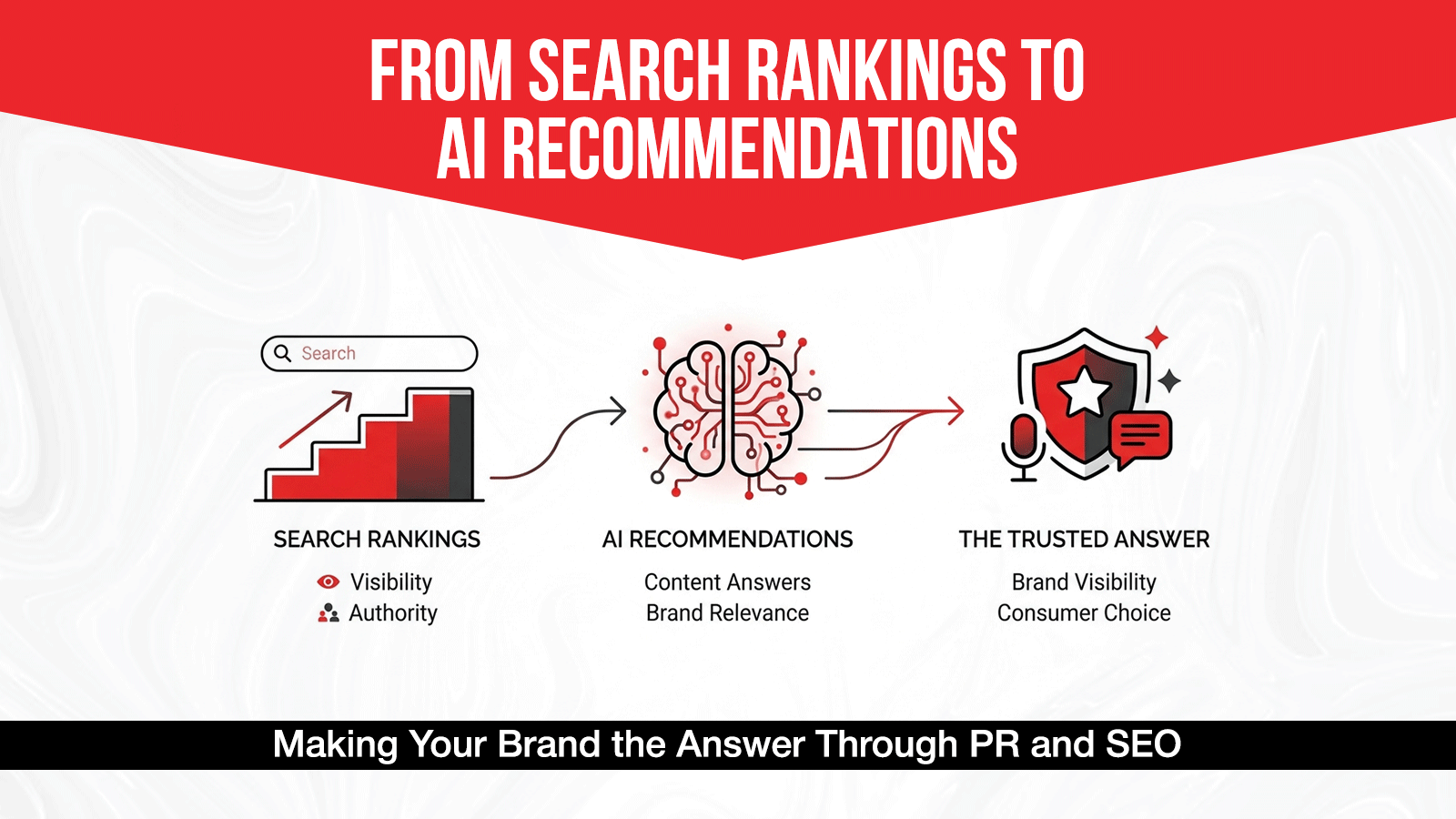
Nowadays, if you ask Google to recommend a brand to you, you get ten links and a few good options to go through. Ask ChatGPT or Gemini the same thing and you get two or three names each with a reason. The first format makes space for many, but the second has room for almost no one.
The question for brands used to be “how do we rank?” Now it’s also “how do we become the answer?” SEO and PR teams now have to answer it together.
When Search Results Turn Into Answers
For about twenty years, the formula was simple. Get noticed, earn clicks, turn visitors into customers. Ranking was the whole game because the click was the only way into your brand.
Now, with the rise of artificial intelligence, another door has opened. With just a single prompt, many people get the summary and never open a link. If you’re named in it, you get attention you didn’t have to pay for. If you’re not, it doesn’t matter how good your pages are, because nobody ever sees them.
Three things follow from this:
- The shortlist is shorter so instead of ten links you’re getting two or three names.
- A mention now does the job a click used to do. Being named in an answer gets you noticed even if nobody visits your site.
- The recommendation feels neutral and that makes it more persuasive than most ads.
Rankings still matter, because strong pages feed these answers. But a good ranking isn’t enough for you to win.
Your Brand Is Judged Before the Click
Think about how you’d shortlist a vendor yourself, especially for B2B. You’d ask an AI tool for options, skim a couple of articles and look up the founders on LinkedIn. By the time you reach anyone’s website, you’d have an opinion.
That means your first impression is probably made somewhere you don’t control. It could be a news feature, an expert quote, a podcast listing or an AI summary pulling from all three. If those say little about you or contradict each other, the buyer shows up unsure. If they all say the same clear thing, the buyer shows up halfway convinced.
That head start is brand trust, and it is earned long before anyone fills in a contact form.
PR and SEO both shape what people believe about you before they talk to you and that’s why they belong in one plan.
What AI Looks For Before It Recommends a Brand
Nobody outside these companies knows exactly how an answer gets assembled and the systems change constantly. It also isn’t one system. Some tools, like Perplexity, Google’s AI Overviews and ChatGPT with search switched on, pull live web pages and cite them. Others lean on what the model absorbed in training. So both what’s published about you now and what has been said about you for years can show up.
Across tools, a few patterns keep appearing and they all reward the same thing, which is what many independent sources agree on.
- A consistent identity – If your site, LinkedIn page, directory listings and press coverage describe you in roughly the same words, the picture is easy to form. If each says something different, the tool tends to play it safe and name someone else. Strong brand management keeps that description the same everywhere.
- Mentions from people with nothing to gain – Coverage in credible publications is one of the signals that seems to matter most. This is partly because it’s hard to fake.
- Named experts – People with real credentials who keep talking about one subject start to read as authorities on it. A brand with a face and a point of view is easier to trust than a logo with a tagline.
- Presence in “best of” and comparison content – Roundups, “top 10” lists and category comparisons often show up in AI answers. That’s why being in them matters.
- Discussion on third-party platforms – Review sites like G2 and Trustpilot, forums, Reddit threads and LinkedIn conversations all feed what tools know about you. Plenty of brands ignore these. Tracking these conversations is a core part of online reputation management.
- Pages that are easy to quote – A page that states its main point in plain language near the top is easier for a tool to understand and reuse.
Only that last item lives entirely on your own site. The rest is built in public, by other people, which is where PR does its work.
How PR Earns the Mentions AI Recommendations Are Built On
AI tools can’t recommend what nobody has written about. Each type of coverage below leaves a different kind of proof.
- Founder and leadership interviews – These tie a named person to a subject and give the brand a voice.
- Expert comments in news stories – These put your spokesperson inside a wider conversation. A two-line quote on an industry shift can do more for your authority than a page describing yourself.
- Bylined articles and op-eds – Each carries your own ideas and the editor’s approval adds weight. Getting published counts as a small endorsement.
- Original research – This gives others something to cite and every citation points back to you. Even a small survey of 100 customers or a look at your own anonymised data can work.
- Awards and recognitions – These are comparative proof, because someone judged you against competitors.
- Podcasts and video – These show how you think under follow-up questions and the transcripts spread your wording across more of the web.
- Roundups and “best of” lists – These are also worth pursuing on purpose.If the articles that rank for your main search terms don’t mention you, that’s a concrete gap to close.
No single format does the whole job. A mix of formats built up over months turns scattered mentions into a pattern that people and machines can both recognise.
Earning Coverage Worth Citing
Reporters get far more pitches than they can use. The ones that land usually have a real point of view backed by experience. They include something specific, like a number or a local detail. They make clear why this outlet’s readers would care. And they also come with a spokesperson who gives short, quotable answers.
If you want to sharpen your angles, our guide to PR storytelling and media coverage is a good place to start.
Relationships matter as much as angles. Journalists remember who was useful last time and who offered a sharp opinion when there was nothing to sell. The brands that stay helpful between announcements are the first ones called when a story needs a credible voice.
How SEO Makes Your Brand Easy for AI to Find, Read and Cite
It would be easy to read all this and decide PR is the whole story. It isn’t. Coverage that points to a weak website gets wasted. Someone (or something) that follows a mention back to your site has to find clear, current information when it arrives. Getting this right is what our SEO and digital marketing services are built for.
SEO covers that side:
- Clear page structure – Put a direct answer in the opening lines so readers and tools can see what you do right away.
- Crawler access – Check your robots.txt. Some sites accidentally block AI search crawlers such as OAI-SearchBot or PerplexityBot, which can keep their pages out of those tools’ answers. Whether to allow training crawlers like GPTBot is a separate business decision, but blocking search crawlers by mistake is just a leak.
- Bing, not just Google – Some assistants, ChatGPT search among them, are widely reported to lean on Bing’s index, so register with Bing Webmaster Tools as well. It also now shows how often Copilot and Bing’s AI answers cite your pages.
- Question-led content – Build pages around what buyers actually ask, using search data, sales calls and support tickets.
SEO also tells PR where to aim. If buyers keep asking the same question, it makes a good theme for an expert comment or a bylined piece.
One Plan for Rankings and Recommendations
The biggest gains rarely come from doing more PR or more SEO. It happens when brands learn to balance both together.
When a founder interview is being planned, SEO can shape the topic around a question buyers already ask and make sure a clear page exists for readers to land on afterwards. When a new page is written, PR can suggest which expert to quote in it and which journalists might find it useful. Coverage then points to content that’s ready for it and the content is backed by voices other than the brand’s own.
Placements also reinforce each other. A feature, a quote and a data-led page that all describe the brand the same way add up to something one-off efforts never manage. Over time that builds a record that outlasts any single news cycle.
Mistakes That Keep Your Brand Out of the Answer
- Treating press releases as the whole strategy: A release nobody picks up adds almost nothing but a newsworthy angle earns real coverage.
- Changing positioning every few months: The web ends up holding several versions of you and no tool knows which to trust.
- Chasing volume over relevance: Two mentions in publications your buyers read beat ten in places they’ve never opened.
- Leaving old pages and profiles live: Outdated details can resurface in AI answers, like an old pricing page, a former CEO or a discontinued service.
- Expecting quick results: Many brands quit just before the effect compounds.
- Taking shortcuts: Mass-produced content, paid placements disguised as editorial and manufactured mentions can look like quick wins. They rarely work in the long run because readers, journalists and the systems that learn from the open web keep getting better at spotting them.
Making Your Brand the Answer
The brands named in tomorrow’s answers will most likely be the ones described clearly, covered fairly and trusted by people with no reason to flatter them. That takes patience and a single plan shared by SEO and PR. SEO makes it easy to find and understand. PR gives you the independent voices that make you worth recommending.
If you want to know where you stand today, start small. Ask an AI assistant the question your customers ask and see who it names. If it isn’t you, that’s useful information you can work with. At Media Maniacs Group a PR agency in Noida, we help brands earn genuine media coverage and build the search foundation behind it so that when the question gets asked, your name has a fair chance of coming up.
Frequently Asked Questions
1. Is SEO still worth the effort when AI gives direct answers?
Answer: Yes. Many AI tools pull from the same web pages that rank in search. So clear, findable content feeds both. See how digital marketing can increase your online visibility.
2. How does PR improve your chances of being recommended by AI?
Answer: PR earns independent coverage. Repeated credible mentions give AI systems more reason to name you and a more consistent description to use.
3. How long does it take for PR and SEO efforts to influence AI visibility?
Answer: It usually takes a few months of steady work. Trust builds slowly, so consistency matters more than speed.
4. Can a smaller brand compete with bigger names?
Answer: Yes. A clear niche, visible experts and relevant coverage can get you the visibility even if you are a small brand. Here is how public relations helps startups build brand awareness.
5. How do you know if AI tools are recommending your brand?
Answer: Ask the major assistants your customers’ questions each month and log when your brand appears, alongside branded search trends.